Context Readiness Is the New AI Coding Benchmark
AI coding assistants have moved from novelty to daily infrastructure. Developers now use tools such as Claude, Cursor, Windsurf, Microsoft Copilot, and other AI-powered coding environments to explain code, generate tests, refactor modules, draft pull requests, and investigate production issues. Adoption is no longer the hard part. The hard part is getting these systems to perform consistently inside complex enterprise software environments.
That shift changes the benchmark. The next performance frontier is not simply which assistant has the largest model, the longest context window, or the most impressive demo. For enterprise teams, the real question is whether the assistant can understand the codebase, policies, dependencies, architectural decisions, security boundaries, and delivery workflows that shape how software actually gets built.
That is why context readiness is becoming the new AI coding benchmark.
AI coding tools are everywhere, but output quality is uneven
Developer adoption has accelerated quickly. Recent developer survey data shows that 84% of developers are using or planning to use AI tools in development, and 51% of professional developers use AI tools daily. That level of adoption makes AI coding performance a board-level productivity conversation, not a side experiment for individual engineers.
The challenge is that adoption has outpaced operating maturity. In the same market data, 66% of developers said they are frustrated by AI solutions that are almost right but not quite. That frustration matters because “almost right” code is not a small problem in enterprise software. It creates review burden, test failures, hidden security risk, and rework that can erase the productivity gains teams expected to capture.
| Enterprise AI coding issue | What teams often assume | What usually happens |
|---|---|---|
| Larger context windows | The assistant will understand more of the system | The assistant may receive more tokens, but not necessarily better context |
| More AI tools | Developers will move faster automatically | Teams often create fragmented workflows and inconsistent outputs |
| Better prompts | Individual users can solve context gaps alone | Prompting helps, but it does not replace structured enterprise knowledge |
| Model upgrades | Accuracy will improve across the SDLC | Model quality helps, but missing repository context still causes mistakes |
The pattern is clear. Enterprises do not have a shortage of AI coding tools. They have a context quality problem.

Context readiness makes the codebase readable to AI
A human engineer does not understand a large codebase by reading every file from top to bottom. They learn the architecture, ownership model, dependency boundaries, test patterns, naming conventions, release process, and institutional decisions that explain why the code works the way it does. AI coding assistants need the same kind of high-signal context.
Context readiness is the discipline of making that knowledge available to AI systems in a structured, governed, and retrievable way. It turns scattered enterprise knowledge into a usable context layer for code assistants and agents.
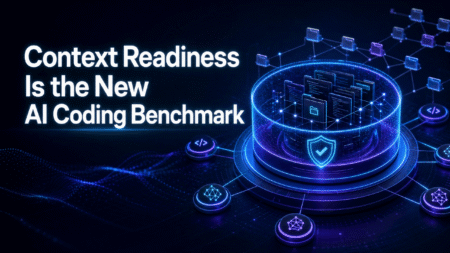
A context-ready enterprise codebase gives AI assistants more than files. It gives them architecture, ownership, policies, tests, dependencies, and runtime context.
A context-ready engineering environment gives assistants access to the right information at the right time. That includes code structure, service boundaries, API contracts, dependency maps, secure coding rules, approved libraries, test conventions, documentation, architectural decisions, and issue intent. It also includes the ability to retrieve that information without flooding the assistant with irrelevant tokens.
This distinction is important. A bigger context window is not the same as better context. Loading more raw code into a prompt can increase cost and noise without improving accuracy. High-performing AI coding environments need context that is curated, current, permission-aware, and specific to the task.
The new benchmark is signal per token
Enterprise AI coding teams should start measuring context quality by signal per token. The goal is not to give the assistant everything. The goal is to give it exactly what it needs to produce useful, reviewable, policy-aligned output.
That shift has direct cost implications. Every unnecessary token consumes compute, adds latency, and can dilute the assistant’s attention. Every missing piece of context increases the odds of near-miss code that requires debugging, review, or rewrite. Better context improves performance on both sides of the equation: lower token waste and lower rework cost.
| Context type | Low-readiness environment | High-readiness environment |
|---|---|---|
| Architecture | Buried in docs, diagrams, and tribal knowledge | Available as retrievable system context |
| Security policy | Shared as static guidelines or review comments | Applied as assistant-accessible guardrails |
| Tests | Discovered manually by the developer | Retrieved with related modules and change patterns |
| Ownership | Known informally by senior engineers | Connected to services, files, and review workflows |
| Business intent | Hidden in tickets and meetings | Carried into task context and PR generation |
When context is structured, assistants stop guessing as often. They can suggest code that is closer to the team’s patterns, write tests that match existing conventions, and avoid recommendations that violate internal standards.
Raw tokens increase input volume. Governed enterprise context improves signal, reduces noise, and helps AI assistants produce output that fits the codebase.
Context readiness should be owned like platform infrastructure
The mistake many enterprises make is treating AI assistant performance as an individual developer issue. If output is poor, the developer is told to prompt better. If code quality is uneven, teams blame the model. If the assistant hallucinates a dependency or misses a policy, organizations treat it as a tool limitation.
Some of that may be true, but it is incomplete. In enterprise environments, AI performance depends on the system surrounding the assistant. Platform teams should treat context readiness the same way they treat CI/CD, observability, identity, and security controls. It is shared infrastructure that every developer and every AI assistant can use.
That infrastructure should answer practical questions. Which parts of the codebase are safe to expose to a given assistant? Which documentation is current? Which service dependencies matter for this change? Which tests should run? Which policy constraints apply? Which prior decisions should shape the recommendation?
Tabnine Context Engine helps enterprises improve context readiness
Tabnine Context Engine is built around this reality. Enterprise teams need AI coding assistants to work with the right codebase knowledge, not just a larger pile of tokens. They need context that respects privacy, governance, security requirements, and organizational boundaries.
By connecting AI coding workflows to structured enterprise context, Tabnine Context Engine helps improve the performance of platforms such as Claude, Cursor, Windsurf, Microsoft Copilot, and other assistants. The objective is not to replace the tools developers already use. The objective is to make those tools more accurate, more consistent, and more enterprise-ready.
For engineering leaders, the immediate opportunity is to assess context readiness across the software estate. Identify where code knowledge is fragmented, where assistant output repeatedly misses local patterns, where reviews catch the same AI-generated issues, and where teams are wasting tokens on low-signal context.
The enterprises that win with AI coding will not be the ones that chase every new assistant. They will be the ones that make their codebases understandable to AI.
Next step: Improve AI coding assistant performance with governed enterprise context. Learn how Tabnine Context Engine helps teams reduce token waste, improve code quality, and lower the hidden cost of AI-generated rework.