//
Subscribe to the Tabnine newsletter
//
Get news and updates about AI, software development, and more.

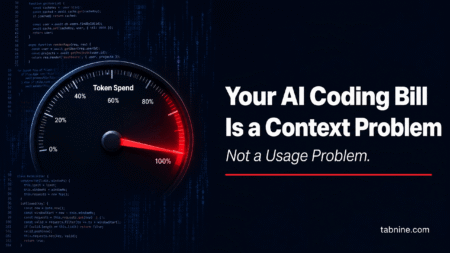
Enterprise AI adoption has officially moved from the experimentation phase to the operational reality phase. With that transition comes a harsh awakening for finance and engineering leaders alike: the hidden economics of Large Language Model (LLM) token consumption.
According to recent forecasts by Gartner, AI coding costs are projected to surpass the average developer’s salary by 2028 due to surging token consumption.[1] We are already seeing reports of organizations burning massive amounts of capital on LLM API calls, driven by inefficient, context-blind AI coding workflows.
To understand why token bills are exploding, we have to look at how most AI coding assistants operate in an enterprise environment.
When a developer asks an AI tool to write a new feature or debug an error, the AI needs context to provide a useful answer. It needs to know about the existing codebase, the architectural patterns, and the internal APIs.
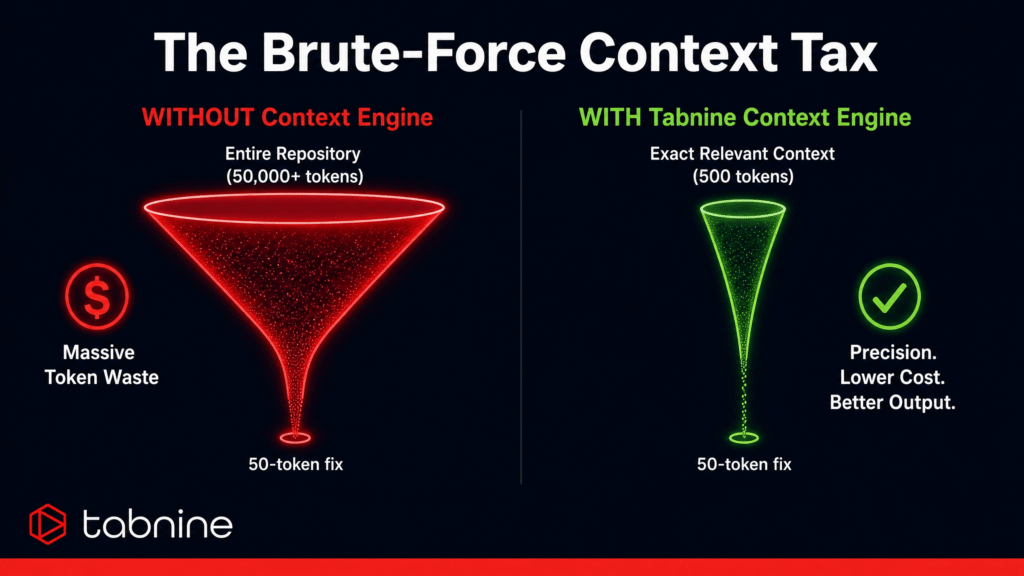
Without a structured way to access this information, most tools rely on brute-force prompting. They stuff massive chunks of repository data, sometimes entire files or directories, into the prompt window, hoping the model will find the relevant needle in the haystack.
This approach is computationally disastrous. You pay for every single input token the model processes. If your AI tool reads 50,000 tokens of irrelevant boilerplate code just to generate a 50-token bug fix, you are paying a massive “reading tax” on every query.
As Gartner Senior Principal Analyst Nitish Tyagi notes, “Token discipline will not emerge through developer choice alone, as developers tend to optimize for speed and convenience over cost efficiency.”[1] Without a governed engineering operating model, costs escalate far faster than the productivity gains the tools are designed to deliver.
The financial impact of brute-force context extends beyond the raw token bill. When an AI tool lacks precise understanding of your specific enterprise architecture, it is forced to guess.
It generates code that is syntactically correct but architecturally flawed. It hallucinates API endpoints that look plausible but do not exist in your internal systems. It reinvents utility functions your team built three years ago.
This “almost right” code is incredibly expensive. It survives initial developer review because it looks correct, only to fail during integration testing or, worse, in production. The resulting code churn and rework cycles eat away at the very productivity gains the AI was supposed to provide.
The solution to the token economy crisis is not to restrict developer access to AI. The solution is to change how the AI accesses your enterprise knowledge.
This is the core value proposition of the Tabnine Context Engine. Rather than relying on brute-force prompting, Tabnine curates and structures your codebase knowledge into a highly efficient, permission-aware graph.
When a developer queries the AI, the Context Engine feeds the model only the exact, relevant context it needs to solve the problem. This precision approach delivers two massive financial benefits:
Find your potential ROI for Tabnine Context Engine using our Token Savings Calculator here.
AI coding tools are transforming software engineering, but they cannot be deployed blindly. Giving an advanced LLM ungoverned access to your codebase without a structured context layer is a recipe for budget overruns.
As the industry shifts toward consumption-based pricing models, context readiness is no longer just an engineering concern. It is a critical FinOps discipline. By deploying the Tabnine Context Engine, enterprises can achieve the productivity promises of AI coding without breaking the bank.
Stop paying for your AI to read code it does not need. Start feeding it the context that matters.

Explore recent posts
//Explore recent posts
//
2 -min read

3 -min read
5 -min read

More How-to's
//3 -min read
4 -min read
4 -min read