//
Subscribe to the Tabnine newsletter
//
Get news and updates about AI, software development, and more.

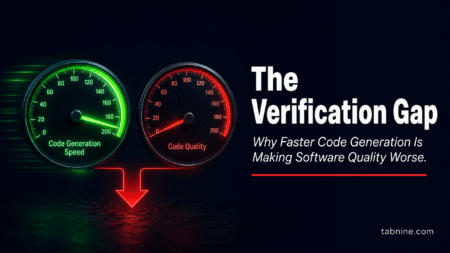
The software engineering industry has successfully solved the code generation problem. Thanks to the rapid adoption of AI coding assistants, the cost and time required to write a line of code have plummeted to near zero.
But this massive increase in velocity has exposed a critical flaw in the modern development pipeline. We are generating code faster than we can safely verify it.
Welcome to the Verification Gap.
When engineering leaders look at AI adoption metrics, the initial data seems overwhelmingly positive. Developers report saving hours per week, and features are being scaffolded at record speed.
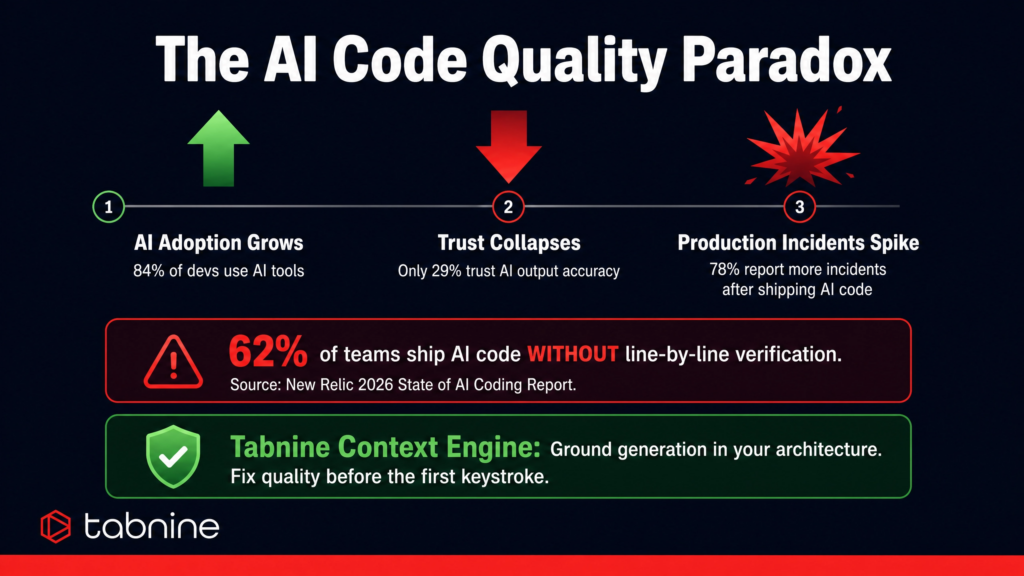
However, a deeper look at production data reveals a troubling reality. According to New Relic’s 2026 State of AI Coding Report, while a majority of tech leaders rate AI-generated code as higher quality than human-authored code during the review phase, 78% report an increase in incidents once that code actually ships to production.[1]
Even more alarming, the same report found that nearly two-thirds (62%) of technology leaders admit their teams confidently ship AI-generated code without line-by-line manual verification.[1]
Why is this happening? Because AI-generated code is often highly plausible. It is syntactically perfect and looks professional, which lulls human reviewers into a false sense of security. But without a deep understanding of the broader enterprise architecture, the AI frequently makes subtle, disastrous assumptions about dependencies, security policies, and internal APIs.
The academic and empirical data supporting this trend is mounting. A large-scale study analyzing 211 million lines of code found that code churn, defined as code revised within two weeks of being written, rose from 3.1% in 2020 to 5.7% in 2024, directly correlating with the increased adoption of AI coding tools.[2]
Furthermore, research highlighted by JetBrains noted that while AI assistance increased initial development velocity, projects experienced a persistent increase in static analysis warnings and code complexity over time.[3]
If your team is generating code 3x faster, but your QA, security review, and debugging cycles are taking 3x longer, you have not actually improved productivity. You have simply shifted the bottleneck to the right, transforming a generation problem into a massive technical debt problem.
To combat this verification crisis, many organizations are turning to AI code review tools. The logic seems sound: if AI wrote the code, use AI to review it.
But this approach introduces a dangerous circular dependency. If you use the same underlying foundational model and the same context assumptions to review the code that you used to generate it, the AI will simply validate its own misunderstandings. If it hallucinated an API endpoint during generation, it will likely approve that same hallucination during review.
As the volume of code explodes, automated review is essential, but it is only valuable if it is independent, deterministic, and grounded in a governed source of truth.
The only sustainable way to close the verification gap is to shift quality to the left. You cannot fix architectural hallucinations at the PR review stage; you have to prevent them at the generation stage.
This is exactly what the Tabnine Context Engine is designed to do.
Instead of letting an AI assistant guess how your systems connect, the Context Engine provides a strict, permission-aware knowledge graph of your actual enterprise architecture, dependencies, and coding standards.
By feeding the AI this deep, structured context before the code is generated, Tabnine ensures that the output aligns with your team’s conventions from the very first keystroke.
When the code is generated correctly the first time, based on your real-world architecture rather than probabilistic guessing, the verification burden drops dramatically. Less rework, fewer PR comments, and a deployment pipeline that can actually handle the speed of AI generation.
Stop optimizing for raw generation speed. Start optimizing for context-grounded quality.
See how the Tabnine Context Engine closes the verification gap at context.tabnine.com

Explore recent posts
//Explore recent posts
//
2 -min read
3 -min read
5 -min read

More How-to's
//3 -min read
4 -min read
4 -min read