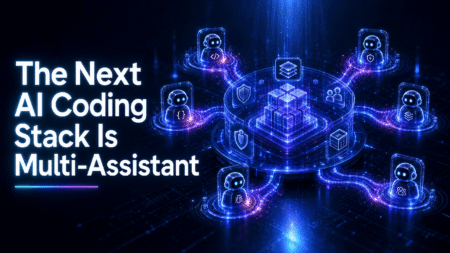
The Next AI Coding Stack Is Multi-Assistant
Enterprise software teams are not standardizing on one AI coding assistant. They are adding many.
One developer may use Cursor for repository navigation, Claude for planning, Microsoft Copilot inside the IDE, Windsurf for agentic workflows, and specialized tools for security, testing, documentation, or pull request review. Platform teams are also experimenting with background coding agents that can pick up issues, create branches, run tests, and open draft pull requests.
This is the direction of the market. The enterprise AI coding stack is becoming multi-assistant.
The risk is fragmentation. If every assistant has its own partial view of the codebase, its own memory, its own policies, and its own interpretation of the task, teams will get inconsistent output. The same repository will be explained differently across tools. The same policy will be applied unevenly. The same architectural rule will be remembered in one workflow and missed in another.
The next priority is not choosing one assistant to replace all others. It is building a shared context fabric that makes every assistant work from the same governed enterprise knowledge.
Agentic coding increases the need for shared context
AI coding assistants are moving deeper into the SDLC. They are no longer limited to autocomplete. They can inspect workspaces, edit files, run commands, evaluate test results, open pull requests, and iterate based on feedback. GitHub’s recent coding agent direction, VS Code agent mode, and the broader rise of agentic IDEs all point to a future where assistants act as contributors inside delivery workflows.
That future depends on context. The more autonomy an assistant has, the more important it becomes that it understands boundaries. Which files should it edit? Which service contracts must remain stable? Which tests are required? Which dependencies are approved? Which security policies apply? Which human owners need to review the change?
Agent adoption already shows a split between individual productivity and team impact. In recent developer survey data, 69% of AI agent users said agents increased productivity, but only 17% said agents improved team collaboration. That gap matters. Enterprise software is built by teams, not isolated prompts.
| Multi-assistant challenge | Enterprise impact |
|---|---|
| Different tools see different context | Output quality varies by assistant and workflow |
| Policies are repeated manually | Developers carry governance burden into every prompt |
| Memory is trapped in sessions | Teams lose context between tasks, tools, and handoffs |
| Agents create pull requests independently | Reviewers need stronger auditability and traceability |
| Context is copied across tools | Token cost rises and sensitive information becomes harder to govern |
A multi-assistant strategy without shared context becomes a coordination problem.
The shared context fabric becomes the control plane
In a mature enterprise AI coding stack, context should not live inside one assistant. It should be reusable infrastructure.
A shared context fabric connects code assistants to the same governed sources of truth: repositories, documentation, architecture decisions, policy rules, issue data, test patterns, service ownership, CI/CD signals, and security requirements. Each assistant can still provide a different experience, but the underlying context becomes consistent.
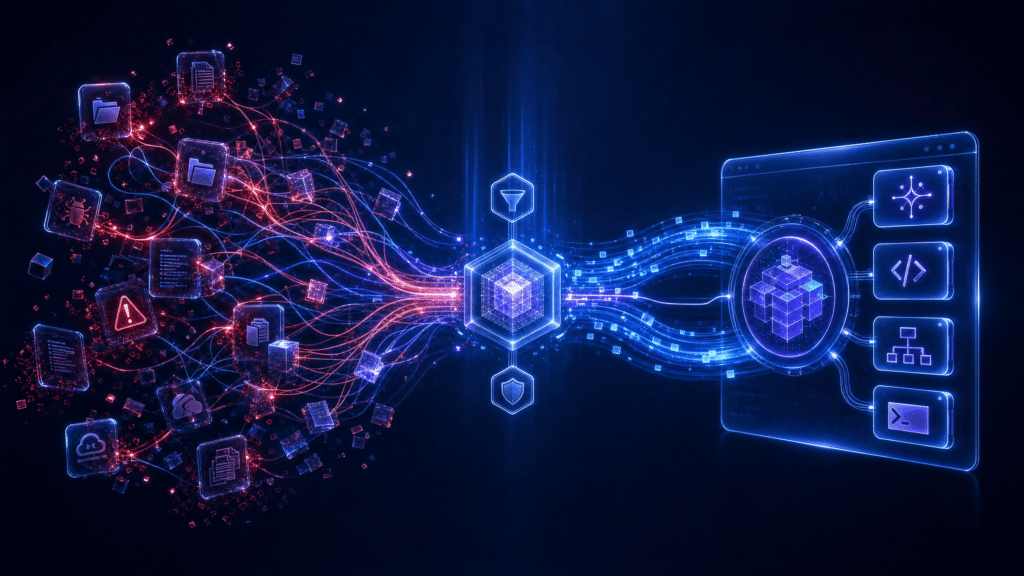
This model gives enterprises more control. Platform teams can define what context is available, which assistants can access it, how sensitive information is handled, and how context is refreshed. Developers get better output without manually reconstructing the same background information in every tool.
The result is not less choice. It is better choice. Teams can use Claude, Cursor, Windsurf, Microsoft Copilot, and other platforms where they fit best while improving consistency through a common context layer.
AI agents need handoffs, not just prompts
As assistants become more agentic, prompt quality remains important, but handoff quality becomes critical. An agent may start from a ticket, inspect the codebase, make changes, run tests, respond to errors, and open a pull request. Each step creates state that the next step needs to understand.
Without shared memory, that state is fragile. Developers may have to restate intent. Reviewers may have to reconstruct the agent’s reasoning. Security teams may have to check whether policy was followed. Platform teams may struggle to audit which context influenced the change.
Governed agent handoffs preserve intent, context, policy, test results, and review evidence across the AI-assisted SDLC.
A governed handoff model should preserve issue intent, relevant code context, assistant actions, test output, policy checks, and review evidence. That does not mean every detail belongs in every prompt. It means the system should maintain a durable record of what the assistant knew, did, and validated.
This is especially important in large automation environments. Modern delivery systems already run at massive scale, with millions of CI/CD jobs and thousands of reusable automation components. AI agents will enter that environment. They need to participate with the same discipline enterprises expect from human contributors and automated pipelines.
Context is the interoperability layer
Enterprises should assume that the AI coding landscape will keep changing. Models will improve. IDEs will evolve. Agent frameworks will mature. New tools will emerge. Standardizing on a single assistant may simplify procurement, but it will not eliminate tool diversity across teams.
The durable investment is context. A well-designed context layer can outlast any single assistant because it captures the enterprise knowledge that every assistant needs. It also gives teams leverage when adopting new tools. Instead of rebuilding governance and repository understanding from scratch, they can connect new assistants to an existing context foundation.
Tabnine Context Engine is designed for that multi-assistant reality. It helps enterprises make codebase knowledge, organizational standards, and development context available in a governed way. That improves the performance of AI coding platforms while helping teams reduce token waste, review friction, and tool-by-tool inconsistency.
Build for the AI software development lifecycle
The AI coding stack is expanding from individual suggestions to full lifecycle participation. Assistants will plan, code, test, review, document, and hand off work across teams. That future will not be managed effectively through isolated prompts.
Enterprises need shared context, shared memory, consistent governance, and measurable outcomes. They need a foundation that lets multiple assistants contribute without multiplying risk or complexity.
The next AI coding stack is multi-assistant. The enterprises that get the most value from it will be the ones that treat context as the control plane.
Next step: Build a shared context foundation for Claude, Cursor, Windsurf, Microsoft Copilot, and the next generation of AI coding agents. Learn how Tabnine Context Engine helps enterprises improve consistency, governance, and performance across the AI-assisted SDLC.