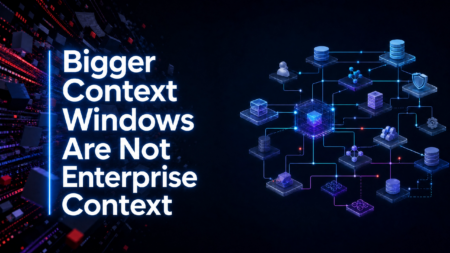
Bigger Context Windows Are Not Enterprise Context
Every few months, the AI market gets a new headline about larger model context windows. The promise sounds simple. If a model can hold more tokens, it should be able to understand more of your codebase. Add more repository files, documentation, tickets, API specs, and policy documents, and the agent should finally have the context it needs.
That is the wrong framing for enterprise software development.
At Tabnine, we believe the enterprise context problem is not solved by giving an AI more text. It is solved by giving AI agents a structured, continuously updated understanding of how your organization builds software. Larger context windows can expose more material. They do not automatically explain which service owns an API, which dependency was banned after an incident, which architectural pattern applies to a business unit, or which internal gateway must be used for service-to-service authentication.
Those are not isolated facts. They are relationships across code, documentation, teams, policies, histories, and systems. Models provide intelligence and agents provide action, but enterprises need understanding. Context is the missing layer that makes AI reliable, safe, and effective inside enterprise development environments.
More input is not the same as more understanding
A context window is a container. It determines how much information a model can consider at once. Retrieval-augmented generation can help select material for that container. Both capabilities are useful, but neither one creates enterprise understanding on its own.
Enterprise understanding requires a living model of the software organization. That model needs to know how repositories relate to services, how services relate to APIs, how APIs relate to consumers, how dependencies relate to risk, how policies constrain decisions, and how ownership affects review. Tabnine Context Engine is built for this job by continuously analyzing and modeling repositories, services, dependencies, APIs, documentation, and architectural relationships.[3]
| Approach | What it gives the agent | Where it breaks in the enterprise |
|---|---|---|
| Larger context window | More tokens available in a single prompt | The model may see more content without knowing which relationships, rules, and histories matter. |
| Basic RAG | Retrieved documents or code snippets related to a query | Retrieval can surface text but often misses architecture, ownership, dependency, and policy relationships. |
| Static documentation | Human-authored explanations of systems and standards | Documentation drifts, omits implicit practices, and rarely captures real-time system state. |
| Tabnine Context Engine | A structured, continuously updated representation of organizational context | It gives agents the relationships and constraints needed to act inside enterprise systems. |

The distinction matters because enterprise development is relational. A change in one repository can affect a service boundary, a downstream API contract, a compliance rule, a security standard, and another team’s roadmap. A model that sees a file and a related document may still miss the blast radius. An agent that can query a structured context layer can reason about the change in the environment where it will actually run.
Why enterprise context must be structured
In a small codebase, context can be implicit. Developers know who owns what. They remember which patterns were deprecated. They can ask the person nearby why the old authentication path still exists. In an enterprise codebase, that knowledge is distributed across repositories, wikis, tickets, API specs, incident reviews, chat histories, and the minds of senior engineers.
AI agents do not absorb organizational memory by osmosis. Without a structured context layer, they generate from generic training data, local files, and whatever the prompt happens to include. The result may compile and still be wrong for the organization.
Tabnine Context Engine combines graph and vector context so agents can understand relationships, dependencies, and architecture, not just text. A vector search can find a relevant paragraph. A graph can represent that Service A depends on Service B, that Team X owns Service B, that Policy Y restricts calls into that service, and that Incident Z involved a prior violation of the same boundary.
Enterprise context is not a pile of tokens. It is an operational map that AI agents can query and reason over so they work from the latest understanding of the system rather than static snapshots of documentation.
That is the difference between showing an AI more content and giving it the organizational context required to act.
The token problem is also a cost problem
The larger-context-window argument also hides an economic issue. If the agent does not know what matters, it explores blindly. It pulls in more files, asks for more context, retries more prompts, and burns more tokens to compensate for the absence of structure. The output can still require review and correction because token volume did not solve the underlying understanding problem.
Organizations using enterprise context commonly see up to 80% reduction in token consumption by eliminating blind exploration, along with up to 2x improvement in accuracy and up to 50% faster time to resolution on complex tasks. That is not just a productivity claim. It is an AI economics claim.
When context is structured, the agent does not need to wander through the codebase to rediscover what the organization already knows. It can be guided toward the relevant services, policies, ownership boundaries, and dependencies from the start. That reduces unnecessary inference, shortens iteration loops, and lowers the review and rework burden on senior engineers.
The enterprise question to ask
The practical question for enterprise AI leaders is not, “How much context can the model hold?” The better question is, “What does the agent understand about our organization before it acts?”
A model with a large context window may still treat your codebase as a document collection. A context-aware platform treats it as a living software system. That distinction changes what an agent can safely do.
| Evaluation question | Why it matters |
|---|---|
| Can the agent identify service ownership before proposing a change? | Ownership determines review, accountability, and escalation paths. |
| Can it understand downstream blast radius? | Enterprise changes rarely stop at the file being edited. |
| Can it apply organization-specific policies during generation? | Post-hoc enforcement creates rework and risk. |
| Can it adapt across multiple agents and IDEs? | Enterprise teams rarely standardize on one tool forever. |
| Can it run within the organization’s trust boundary? | Architecture, incident history, and policy data are highly sensitive. |
Tabnine is built around this architecture. The context layer works with preferred models, IDEs, and deployment environments, including SaaS, VPC, on-premises, and air-gapped environments.
The future belongs to context-aware agents
Bigger context windows will continue to be useful. Better retrieval will continue to matter. But neither should be mistaken for enterprise context.
The next phase of AI software development will not be defined by the number of tokens an agent can ingest. It will be defined by whether the agent can act with an accurate, current, and governed understanding of the organization it serves.
That is the role of Tabnine Context Engine. It gives AI agents the structured organizational context they need to move from plausible code to enterprise-ready software.
Learn how Tabnine Context Engine gives AI agents structured organizational context below.