//
Subscribe to the Tabnine newsletter
//
Get news and updates about AI, software development, and more.

Over the past two years, AI models have advanced at an extraordinary pace. Larger models, faster inference, and more capable agents have dramatically improved what AI can generate.
But inside real enterprise development environments, many organizations are discovering a different reality.
Model capability alone does not guarantee useful AI.
The reason is simple. Most AI systems do not understand the environments they are operating in.
Without that context, AI operates on fragments of information rather than a structured understanding of the system. The result is often familiar to engineering leaders: plausible output that still requires extensive review, rework, and validation.
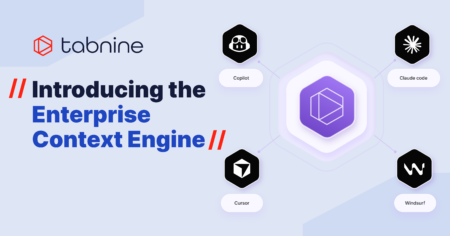
To solve this challenge, Tabnine is introducing the Enterprise Context Engine, a new infrastructure layer designed to give AI systems a structured understanding of the environments in which they operate.
Most organizations think about AI systems in terms of models and applications.
A model generates output.
An agent or application delivers that output to users.
But between the model and the enterprise environment, an important layer has been missing.
AI needs structured context in order to operate safely and effectively inside complex production systems.
The Enterprise Context Engine provides that missing layer.
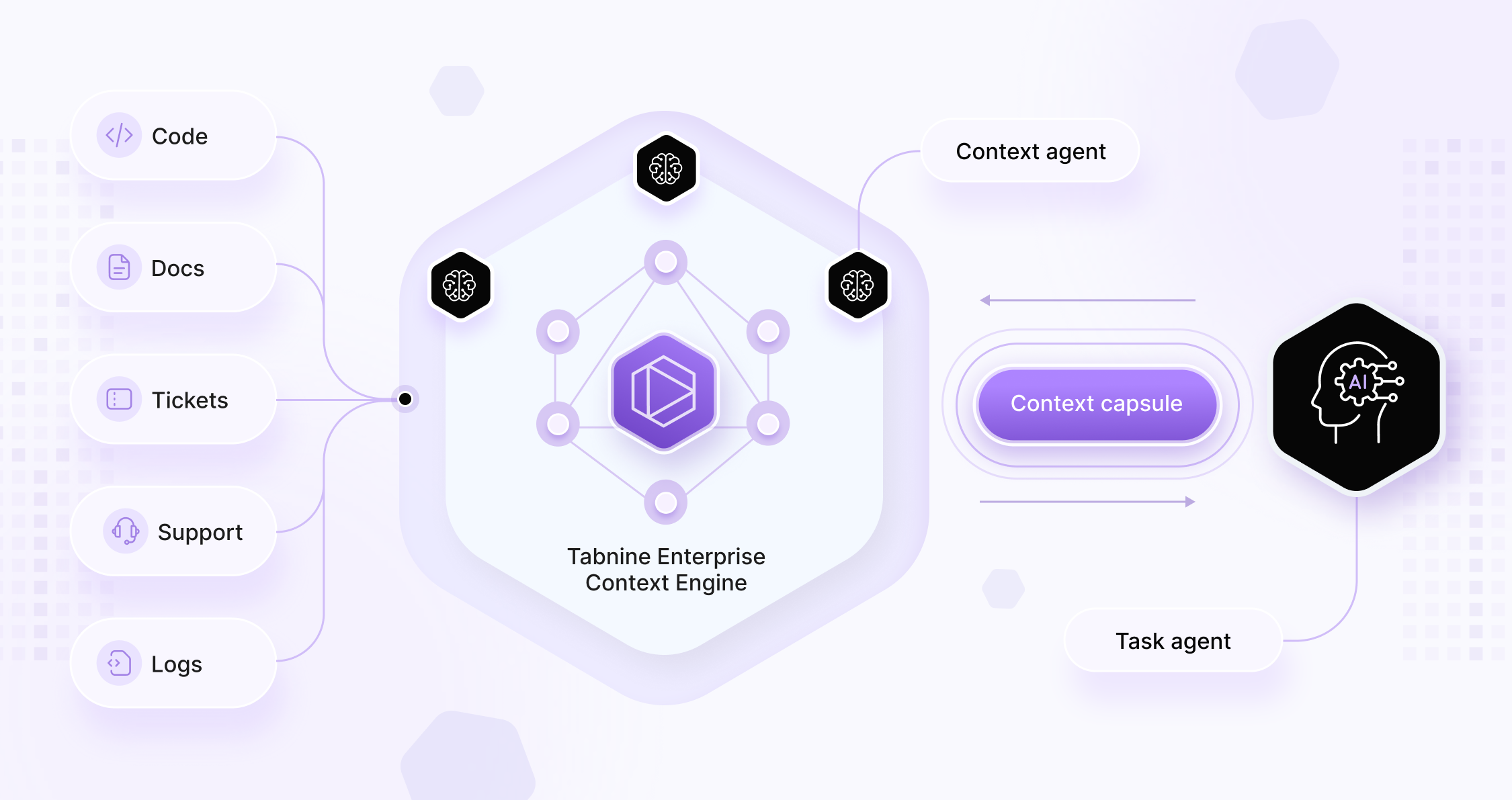
It continuously analyzes and models an organization’s software environment including repositories, services, dependencies, APIs, documentation, and architectural relationships. This information is then structured and made accessible to AI systems so they can reason about changes in the context of the entire system.
Instead of operating on isolated files or documents, AI gains a structured map of the environment it is working within.
Without structured enterprise context, AI generated code often requires significant human correction before it can be safely deployed.
Engineering leaders frequently report several common patterns:
These issues do not arise because the models are incapable. They arise because the models lack situational awareness of the systems they are modifying.
The Enterprise Context Engine changes that dynamic by giving AI systems access to structured knowledge of the environment in which they operate.
When AI understands architecture and dependencies, the quality of generated output improves dramatically.
Engineering teams can catch breaking changes earlier.
Impact analysis becomes faster and more reliable.
Code review becomes more focused and efficient.
Policy enforcement can occur before changes reach production.
The result is AI that is more aligned with the realities of enterprise development.
Many engineering teams have already adopted AI coding tools such as Claude Code, Cursor, Copilot, and other AI development assistants.
These tools have dramatically improved developer productivity. They help developers write code faster, generate tests, explain unfamiliar code, and accelerate everyday development tasks.
However, these systems typically operate with limited visibility into the broader enterprise environment. They can access files, prompts, and retrieved documents, but they often lack a structured understanding of how the entire system fits together.
The Enterprise Context Engine complements these tools rather than replacing them.
By providing a structured representation of repositories, services, APIs, dependencies, and architectural relationships, the Context Engine allows AI tools to operate with a deeper understanding of the system.
For example, when AI generates a code change, the Context Engine can help determine:
This allows developers to continue using the tools they prefer while giving those tools the enterprise context needed to operate more intelligently.
Instead of replacing AI coding assistants, the Enterprise Context Engine makes them better.
The Enterprise Context Engine builds and maintains a continuously updated representation of an organization’s software environment.
This includes:
This information is organized into a structured knowledge model that AI systems can query and reason over.
Because the context is continuously updated, AI agents and coding assistants can work with the latest understanding of the system rather than static snapshots of documentation.
The result is AI that can reason about software changes in the context of the full environment.
Enterprise organizations require more than powerful models. They require governance, control, and deployment flexibility.
The Enterprise Context Engine is designed to meet those needs.
It supports deployment across SaaS, VPC, on premises, and air gapped environments.
It integrates with existing developer workflows and CI/CD pipelines.
It enables policy enforcement and compliance validation during development rather than after deployment.
Most importantly, it allows organizations to use the AI tools of their choice while adding the structured context required for enterprise scale.
The next phase of enterprise AI will not be defined solely by model innovation.
It will be defined by infrastructure that allows those models to operate safely and effectively inside complex production systems.
Just as data warehouses transformed analytics by providing structured access to organizational data, context infrastructure will transform AI by giving models a structured understanding of the environments they interact with.
The Enterprise Context Engine represents a step toward that future.
By giving AI systems a structured understanding of architecture, dependencies, and organizational constraints, enterprises can move beyond experimentation and begin realizing the full potential of AI in software development.
To learn more about how the Enterprise Context Engine works and how it can enhance your existing AI development workflows, visit:
https://context.tabnine.com
Explore recent posts
//Explore recent posts
//
2 -min read
3 -min read
4 -min read

More Product News
//4 -min read
< 1 -min read
3 -min read