//
Subscribe to the Tabnine newsletter
//
Get news and updates about AI, software development, and more.

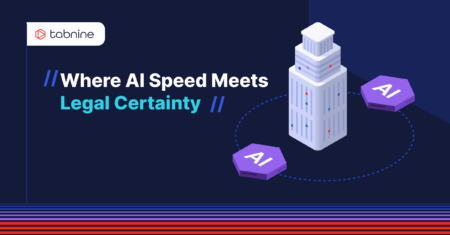
AI coding assistants have changed the speed of software development. Engineers can move faster, prototype faster, and ship faster. But speed introduces a new risk surface. When AI generates code, where did it come from? And what obligations might be attached to it?
This is not just a philosophical question. It is a legal and operational one.
Tabnine’s Provenance and Attribution capability was designed to answer that question directly. Instead of treating AI output as opaque text, it enables teams to understand whether generated code matches publicly available repositories and what license governs that original source. When the system detects a match, it surfaces the repository and the license metadata so teams can make informed decisions.
That is powerful at the developer level. But the real leverage comes when you elevate provenance checks into your CI/CD process.
Developers work quickly. They accept suggestions, refactor, move on. Code review focuses on correctness and performance. Rarely does a reviewer pause to ask whether a particular function might closely resemble GPL code from a public repository.
The moment that matters most is not when the code is suggested. It is when that code becomes part of your main branch and eventually part of your distributed product.
If a non-permissive license contaminates your proprietary codebase, the downstream consequences can include:
Running provenance and attribution checks inside CI/CD shifts the responsibility from individual awareness to automated governance. It ensures that no matter how fast developers move, nothing lands in production without being screened for license risk.
For startups, license issues are painful. For enterprises, they are existential.
Public companies, regulated industries, and defense contractors operate under strict compliance regimes. They cannot afford ambiguity about the origins of their code. During acquisitions or funding rounds, code provenance often becomes part of diligence. Buyers want to know that the IP is clean.
By embedding provenance checks in CI/CD, you create:
An auditable compliance record
Every merge has passed a documented license screen. That is defensible in audits and negotiations.
Policy enforcement at the system level
Instead of relying on training and good intentions, you encode your license policy into the build pipeline.
Reduced downstream liability
Problems are caught before distribution, not after customer deployment.
This is the difference between reactive legal cleanup and proactive IP governance.
CI/CD pipelines already enforce security scans, unit tests, static analysis, and dependency checks. Provenance is simply the next logical control.
Think about how organizations treat container vulnerabilities. You would never allow a known CVE to ship simply because a developer overlooked it. You scan automatically and block the build.
License risk deserves the same treatment.
When Tabnine’s provenance and attribution checks are integrated into CI/CD, you create a license-aware build process. If generated code matches a repository under a license your organization does not permit, the pipeline can block the merge or require review. The system becomes the guardrail.
That does two things:
There is another dimension here that is often overlooked.
Enterprise customers increasingly ask vendors about AI governance. They want to know:
If your development process includes automated provenance checks in CI/CD, you have a clear answer. You are not just using AI responsibly. You are enforcing responsible AI at the infrastructure level.
That becomes a selling point in regulated markets. It shortens procurement cycles. It builds trust with security teams. It differentiates you from vendors who treat AI output as a black box.
AI is accelerating software development. That acceleration does not have to come at the cost of IP hygiene.
Tabnine’s Provenance and Attribution feature gives you visibility into the origins of generated code. Integrating that capability into your CI/CD pipeline turns visibility into enforcement. It transforms compliance from a manual, error-prone review task into an automated control.
The result is simple:
Developers move fast.
The pipeline enforces policy.
The organization stays protected.
That is how AI coding at scale should work. That’s AI you can trust.
Explore recent posts
//Explore recent posts
//
2 -min read
3 -min read
3 -min read

More Product News
//3 -min read
2 -min read
3 -min read