//
Subscribe to the Tabnine newsletter
//
Get news and updates about AI, software development, and more.

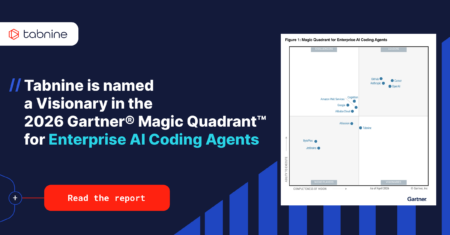
We are excited to share that Tabnine has been named a Visionary in the 2026 Gartner® Magic Quadrant™ for Enterprise AI Coding Agents.
For us, this recognition reflects an important shift happening across enterprise software development. AI coding is rapidly evolving from isolated developer assistance into something much larger: intelligent software delivery systems that operate across teams, repositories, policies, infrastructure, and workflows.
Over the past year, the market conversation has expanded well beyond code completion. Enterprises are now asking harder questions:
These are the problems we have been focused on solving.

The first generation of AI coding tools proved that large language models could accelerate software development tasks. But enterprise software delivery introduces a different level of complexity.
Code does not exist in isolation. It exists inside systems, standards, dependencies, architectural boundaries, security controls, and organizational knowledge that have evolved over years.
This is why we believe context is becoming the defining layer of enterprise AI coding.
Without organizational context, agents can generate code that appears correct while violating internal standards, introducing architectural drift, duplicating logic, or creating operational risk. Faster output alone is not enough. Enterprise teams need systems that can reason within the realities of their organization.
That belief led us to invest heavily in the Tabnine Enterprise Context Engine and our broader AI coding platform.
Our focus has been on building infrastructure for trusted AI software delivery.
That includes:
We believe enterprise adoption increasingly depends on these foundational capabilities.
Many organizations are no longer evaluating AI coding tools based only on autocomplete quality or benchmark performance. They are evaluating whether AI systems can operate reliably within the constraints of real-world software engineering organizations.
Another trend we continue to see is the shift from individual developer productivity toward overall engineering team productivity.
The industry is moving from isolated AI interactions toward coordinated workflows involving developers, agents, reviewers, testing systems, deployment pipelines, governance layers, and organizational knowledge systems.
In that environment, context and coordination become critical.
AI agents need to understand not only how to generate code, but how software is built inside a specific organization.
We are proud of this recognition, but we also believe the market is still in the early stages of defining what enterprise AI coding ultimately becomes.
The next era will likely be shaped by platforms that combine intelligence, context, governance, and operational trust into a unified system for software delivery.
That is the direction we are building toward.
We look forward to continuing to work with our customers and partners as the category evolves.
Gartner does not endorse any vendor, product or service depicted in its research publications and does not advise technology users to select only those vendors with the highest ratings or other designation. Gartner research publications consist of the opinions of Gartner’s research organization and should not be construed as statements of fact. Gartner disclaims all warranties, expressed or implied, with respect to this research, including any warranties of merchantability or fitness for a particular purpose.
GARTNER is a registered trademark and service mark of Gartner and Magic Quadrant is a registered trademark of Gartner, Inc. and/or its affiliates in the U.S. and internationally and are used herein with permission. All rights reserved.
Magic Quadrant for Enterprise AI Coding Agents
20 May 2026 – ID G00841434 By: Philip Walsh, Keith Holloway, Matt Brasier, Nitish Tyagi, Neha Agarwal
Explore recent posts
//Explore recent posts
//
2 -min read
3 -min read
3 -min read

More Product News
//3 -min read
2 -min read
3 -min read