//
Subscribe to the Tabnine newsletter
//
Get news and updates about AI, software development, and more.

As AI agents move from experimentation into real production environments, one thing becomes clear very quickly: this is no longer just a productivity conversation. It is a governance conversation.
Enterprises are not asking, “Can AI help our developers move faster?”
They are asking, “Can we trust it inside our systems?”
Trust means control. It means boundaries. It means the ability to adopt agent-driven development without introducing new categories of risk.
Governance and security have been part of Tabnine’s DNA from day one. With 6.1, we are pushing that foundation further, introducing enhanced controls and safeguards that make it even easier to operate AI agents safely at enterprise scale.
One of the biggest risks with agent-driven development is also one of its greatest strengths: the ability to execute actions directly in a developer’s environment.
Without guardrails, that power can become dangerous.
An agent that can run commands without restriction can accidentally modify critical files, disrupt environments, or introduce instability. For enterprise teams, that risk is unacceptable.
In 6.1, we have hardened the CLI sandboxing layer. This ensures that agents operate within controlled, isolated boundaries rather than directly in the user’s unrestricted environment.
This is not just a technical enhancement. It is a prerequisite for enterprise adoption.
Sandboxing prevents accidental damage to production systems, reduces the blast radius of agent actions, and reinforces a secure-by-design architecture. It allows organizations to benefit from automation without exposing themselves to unnecessary risk.
Security teams do not want vague assurances. They want control at the level where risk actually occurs.
We now provide fine-grained, per-command permissions that can be configured by both users and administrators. Commands can be set to:
This applies not just to individual commands, but to entire categories via command prefixes such as git, npm, or docker. Even chained commands are intelligently parsed and governed, with the strictest permission applied across the entire chain.
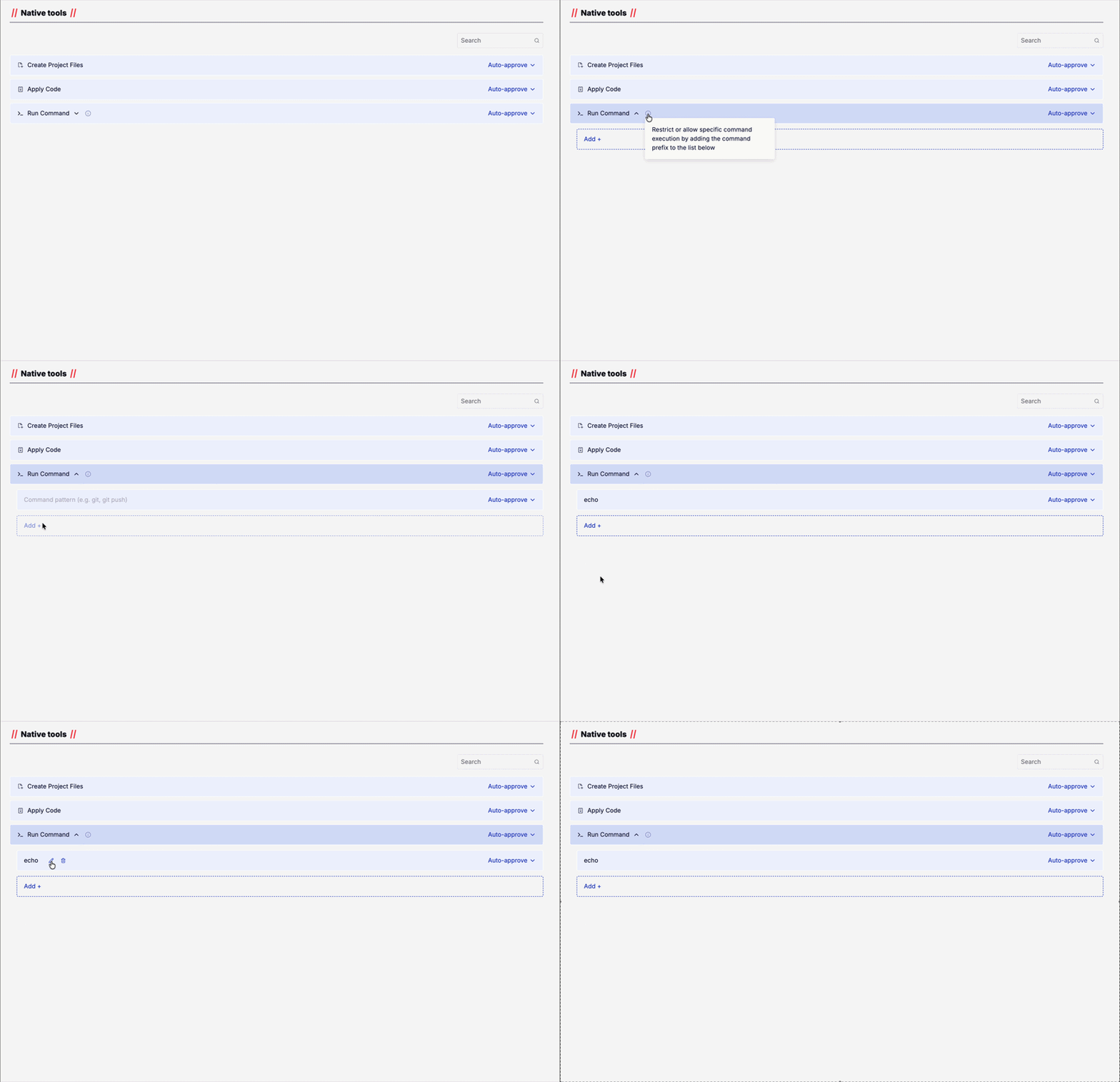
This level of control unlocks real enterprise adoption.
Security teams can now define exactly how automation behaves. They can start with strict policies and gradually relax them as confidence grows. Every action becomes governed, predictable, and aligned with organizational standards.
While many tools offer binary “on or off” controls, Tabnine provides the precision required for real-world enterprise environments.
Another critical concern with AI agents is access to data.
If an agent can read or modify files outside of its intended scope, it creates the risk of data leakage, unauthorized changes, or exploitation through prompt injection attacks.
File operations can now be hard-restricted to the active workspace boundary. Any attempt to access files outside of that scope is automatically blocked.
This includes protections against accessing sensitive system paths such as /etc/passwd or private directories like ~/.ssh.
The result is a clear and enforceable boundary around where agents can operate.
For security-conscious organizations, this is a critical requirement. It ensures that agents interact only with the code and assets they are explicitly allowed to access, reducing the risk of both accidental exposure and malicious exploitation.
Taken together, these capabilities represent something larger than individual features.
They represent a shift from AI as a tool to AI as infrastructure.
Enterprises are not just adopting agents to write code faster. They are integrating them into their development workflows, CI/CD pipelines, and production environments. That requires a level of governance that matches the importance of those systems.
Tabnine delivers that foundation.
This is how organizations move from experimentation to deployment with confidence.
Because in enterprise AI, speed matters. But trust is what determines whether adoption actually happens.
Explore recent posts
//Explore recent posts
//
2 -min read
3 -min read
3 -min read

More Product News
//3 -min read
2 -min read
3 -min read