Watch Now
Announcing the launch of Org-Native Agents.

//Tabnine vs. Windsurf//

Unlike Windsurf, (formerly Codeium), Tabnine is designed to work directly across the tools enterprises already use. Windsurf bundles its own IDE experience with agent-like features, but this comes with vendor lock-in and early-stage maturity. Tabnine is proven at scale, with over one million monthly active users, enterprise-ready compliance, and steerable AI coding unmatched by Windsurf.
//

Why enterprises and individual developers choose Tabnine over Windsurf

//
Enterprise-grade control
  • Tabnine enables centralized administration, analytics, usage monitoring, and enforceable coding standards.
  • Windsurf emphasizes developer productivity but lacks org-wide governance or policy enforcement.
Org-aware intelligence
  • Tabnine’s Context Engine integrates with your repos, Jira, and Confluence to deliver relevant, policy-compliant suggestions.
  • Windsurf provides project-scoped context inside its IDE but lacks enterprise knowledge integration.
Steerable AI coding
  • Tabnine empowers enterprises to steer AI output with coding standards, policies, and org-specific preferences.
  • Windsurf’s Cascade agent is powerful but harder to direct, with limited fine-grained control.
Flexible deployment
  • Tabnine runs in SaaS, VPC, on-premises, or fully air-gapped environments.
  • Certified for SOC 2, GDPR, HIPAA, ITAR, with zero-retention policies and indemnification.
  • Windsurf is a cloud-first IDE with no air-gapped or self-hosted option, and no enterprise compliance guarantees.
//

Side-by-side comparison  

//
Check out this detailed comparison of the key capabilities of Tabnine and Windsurf
Code completion
Autogenerates code snippets and full functions as you type
Generates code automatically from written comments
Chat
Ask general coding questions and get relevant recommendations
Chat-first agent via Cascade
Use natural language to generate code based on your specifications
Automatic generation of documentation for selected code
Manual
Recommend fixes to selected code with error(s)
Requires manual prompting
Automatic generation of comprehensive test plans
Plain language explanation of the purpose and behavior of selected code
Ability to automatically update or refactor selected code
Dedicated onboarding to enable developers to quickly onboard to a new project
Privacy
SOC 2 Type 2 compliance
Zero data retention policy (both for code and usage metrics)
Indemnification against IP violations for any and all generated code
License dependent
Models
Switchable models for chat
OpenAI, Anthropic, Cohere, Mistral, and all major models
Claude/GPT models only
Model flexibility
BYOM + multi-provider support
limited to Claude/GPT
Cost predictability / token usage billing
Flat per-seat pricing; token usage absorbed
Usage-based billing via model provider
Org-Awareness
Org-aware context engine
Limited to open project scope
Steerability
Ability to enforce org-specific coding standards
Admins can encode coding rules, linting preferences, naming conventions, etc., into AI behavior)
No built-in governance; relies on user prompting
Policy-based control of AI suggestions
Centralized policy settings across teams, e.g., restrict suggestion types, enforce secure code practices
No centralized controls
Granular control of agent behavior
Steer output toward compliance, security, style requirements
Cascade agent executes tasks but lacks fine-grained steerability; difficult to constrain behavior
//

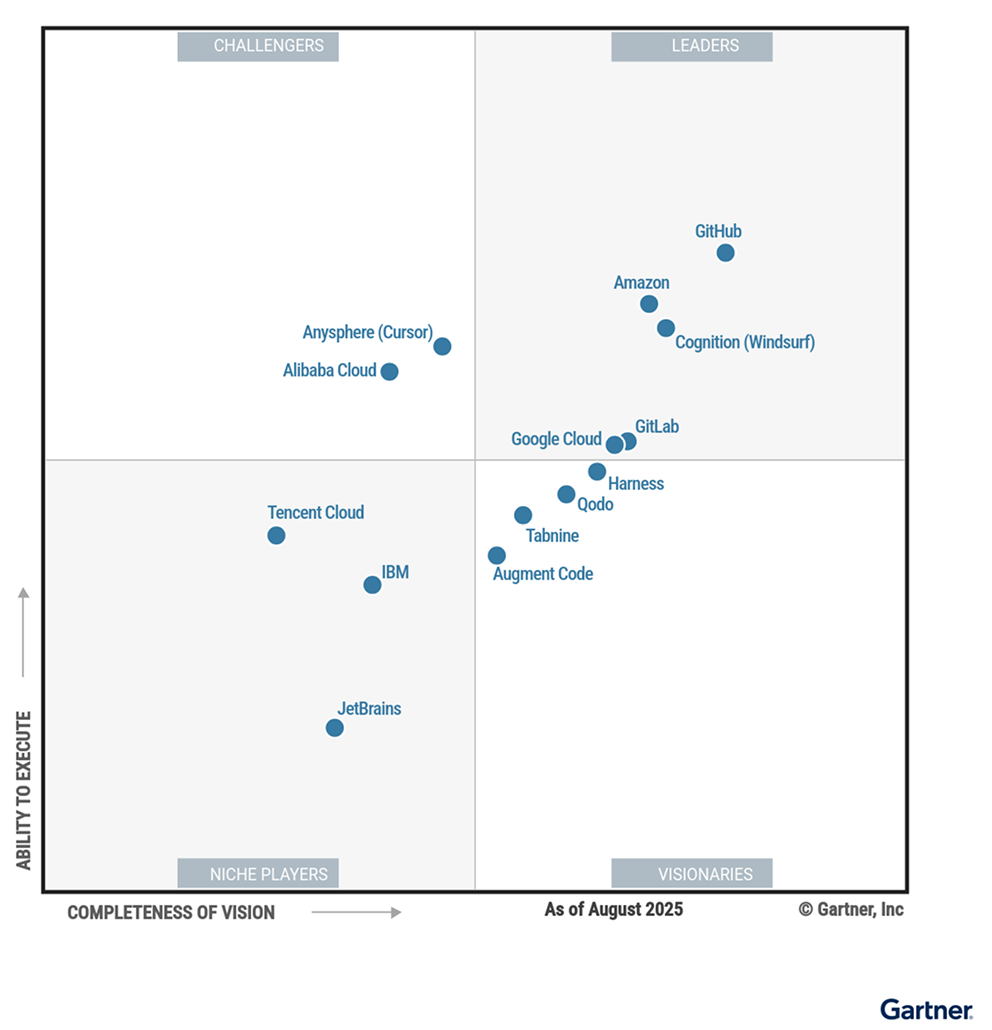
Tabnine is named a Visionary in the September 2025 Gartner® Magic Quadrant™
for AI Code Assistants

//